Go to content

Discontinuation of unstructured addresses

By November 2026 an important industry wide change will affect how address information must be provided in payment messages, in the case the address information is used.

To ensure continued seamless processing of your payments you must use either: 

  1. Structured address format, or
  2. Hybrid address format (key address fields structured, with limited free text lines)

After this deadline, payments sent with unstructured addresses may be delayed, rejected, or require manual correction, potentially affecting your operational timelines.

How do I as a customer need to prepare?

If you initiate payments via file, please ensure that your vendor records include Town Name and Country Code, new minimum requirement. 

  1. Update your vendor data (beneficiary/payee data): Regardless of whether you choose a structured or hybrid address format, you must provide at least a structured Town Name and structured Country Code for every party address. If this information is missing in your current counterparty data records, we recommend prioritising outreach to your payees and beginning to collect these details as soon as possible. This change will ultimately affect all payment types why we recommend you cover all types from start when working on your vendor data. 

  2. Review payment file generation: If not already done, update your payment initiation systems (ERP, TMS, host-to-host formats) to support ISO 20022 messaging with structured or hybrid postal address fields.

Payment types impacted

This change will ultimately affect all payment types why we recommend you cover all types from start when working on your vendor data.  

By November 2026: International (Swift) payments, SEPA Credit Transfers, SEPA instant payments and SEPA Direct Debits, SEK Credit Transfers, BG / PG payments and DKK Credit Transfers.

Migration to ISO 20022 and pain.001

To fully benefit from this transition, we strongly recommend migrating to the ISO 20022 messaging standard, specifically using the pain.001 message format for payment initiation.

Why this change?

This update is part of the global move to ISO 20022 standard, now being adopted by major financial network and clearing systems around the world. Switching to structured or hybrid addresses will:

  • Improve data quality and reduce errors
  • Increase straight through processing (STP) of your payments
  • Align your processes with global payment standards

Market practices are still being established around the discontinuation of unstructured addresses, and we will continuously update this page when practices are established.

Support

For more information we refer to this industry guide: PMPG Hybrid Address Industry Guidance [pdf]

SEB’s ISO 20022 Message Implementation Guidelines (MIG) are already updated.

SEB MIG for Credit Transfers pain.001 V3 (zip) 

SEB MIG for Credit Transfers pain.001 V9 (zip)

For testing and implementation support go to File testing – SEB Test Bench: 
File testing with SEB Test Bench

You can also test your files in Business Arena. You find it via the main menu under: Products and services /Test ISO files.

Below you find additional information around the steps we recommend you take as well as more detailed instructions now available to the market for your support. The focus is on how you use the address field, if you use it.


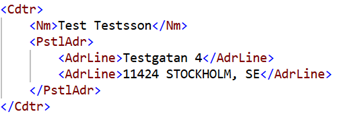
Today – Unstructured address

  • Optional field but in use today
  • Can be used until Nov 2026

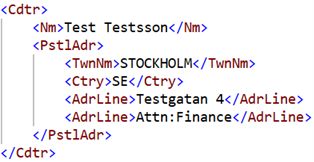
Hybrid address

  • Can be used today
  • Is minimum mandatory requirement starting Nov 2026 (if address field is used)

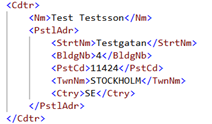
Structured address

  •  Can be used today
  •  Market preferred and recommended option
  1. Update your vendor data

    If your payment counterparty data records do not currently include the Town Name and Country Code for these parties, please prioritise reaching out to your payees and begin collecting this information as soon as possible.

    Timely action is essential to ensure compliance with the upcoming requirements and to avoid any disruption to your payment processing.  Ensure that all payment counterparty data management processes are well established with necessary controls and the updated information will be available at all your payment processing systems. In case the town name and country code data is not at all available as separate fields in your master vendor data entries, please contact your system vendor and consult how to get the data fields available before November 2026.

  2. Review payment and direct debit initiation file generation

    If not already done, update your payment initiation systems (ERP, TMS, host-to-host formats) to support ISO 20022 messaging with structured or hybrid postal address fields. Examples include XML pain.001 and pain.008 formats that support mandatory town and country fields.

    I.    Review and assess your existing payment initiation systems and data formats, including legacy formats such as MT101 or proprietary files.

    II.    If you are not already doing so, prepare to support the hybrid or fully structured postal address format by November 2026.

    III.    Ensure that, all postal addresses, provided for the:
    – Debtor (this information is typically provided by the Debtor Agent based on data captured during customer onboarding/KYC)
    – CreditorUltimate Debtor/Creditor (if applicable)
    –And related agents (usually the banks), if no Agent BIC is available, are submitted using either the fully structured or hybrid format.

    IV.    Whether using the fully structured or hybrid format, you must anyway provide at least a structured Town Name and a structured Country Code (ISO 3166-1 2-letter format) for each party address

    V.    If you are still using MT messages or other non-ISO 20022 communication protocols, please ensure that address data includes Town Name and Country as structured elements, even when submitted via semi-structured fields. 

Example using the MT101 Field 59 (F-option) format for a hybrid postal address: 

:59F:/BE30001216371411
1/JOHN SMITH
2/HOOGSTRAAT 6, 18TH FLOOR
3/BE/BRUSSELS, 1000

Where: 
1/= Name (JOHN SMITH)
2/=Address Line (HOOGSTRAAT 6, 18TH FLOOR)
3/=Country Code (BE), Town Name (BRUSSELS), and Postal Code (1000)

Attention:

For pain.001 version 3 and version 9, the fully unstructured postal address option allows up to 7 lines of Address Line (AdrLine), providing flexibility for complex addresses. However, when using the hybrid postal address format, only 2 lines of AdrLine are permitted. Please ensure your systems and data mapping reflect this limitation to avoid processing issues.

The hybrid postal address allows for a combination of structured and unstructured address data. At minimum, it requires:

    • A structured Town Name
    • A structured Country Code (ISO 3166-1 2-letter format)

The rest of the address (e.g., post code, street name, building details) may be included in maximum of two lines of unstructured text (Address Line), but these must not duplicate the structured fields.

Example:

<PstlAdr>
  <TwnNm>BRUSSELS</TwnNm>
  <Ctry>BE</Ctry>
  <AdrLine>HOOGSTRAAT 6, 18TH FLOOR, 1000</AdrLine>
</PstlAdr>

Frequently asked questions

Find answers to the most frequently asked questions about discontinuation of unstructured addresses.

This change will ultimately affect all payment types why we recommend you cover all types from start when working on your vendor data and payment initiation file creation. 

By November 2026: 

International (Swift) payments, SEPA Credit Transfers, SEPA instant payments and SEPA Direct Debits,
SEK Credit Transfers (incl. Swedish Express Payments), BG / PG payments and 
DKK Credit Transfers (incl. National bank transfer).

This is a worldwide industry change that affects all banks globally.

You can perform the changes a soon as you like.

Yes, the minimum requirements are to enter the Town Name and Country Code, if you use the address field and enter an address in structured or hybrid format.

Yes, it does.

All parties and Agents (banks) must follow these address rules, yet in the Agents’ case, no address will not be needed nor recommended when bank’s BIC code is used.

Yes, both tools below are able to report possible address structure errors in various payment types and their sample files.

This will allow you to validate your files in advance and ensure readiness before the November 2026 implementation date.

Please note, the address validation is simple with rules, that both Town Name and Country Code exist in the given address and there are maximum of two or less unstructured address lines given (as possible in the hybrid address variant).

This update is part of the global move to ISO 20022 standard, now being adopted by major financial network and clearing systems around the world. Switching to structured or hybrid addresses will:

  • Improve data quality and reduce errors
  • Increase straight through processing (STP) of your payments
  • Align your processes with global payment standards.

Contact our experts within cash management

Our dedicated team of experts is here to guide you through the complexities of local market dynamics, finding flexible solutions to streamline your day-to-day operations. Together with you, we will support your expansion across borders and ensure that your global treasury needs are met. 


Up